
Publications
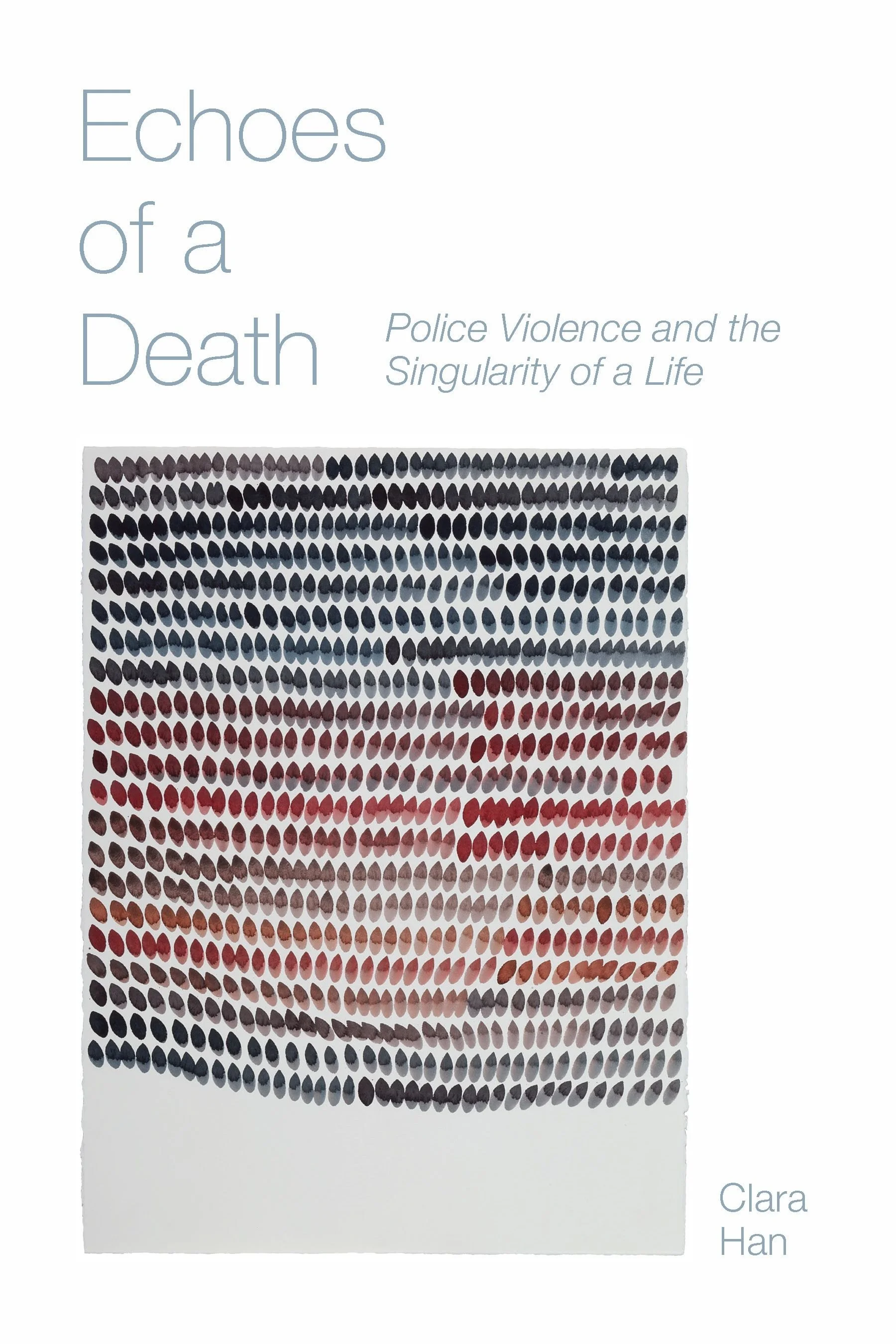
Echoes of A Death: Police Violence and the Singularity of a life (fordham, 2026)
Clara Han
In neighborhoods subject to concentrated policing, deaths at the hands of police have become so pervasive that they are a feature of everyday life. But the loss of a human being—a child, sibling, parent, lover, or neighbor—cannot be normalized. It is always lived in the singular. Echoes of a Death traces how a police killing unfolds in a low-income neighborhood in Santiago, Chile that has been under a police occupation for decades as part of the country’s war on drugs and on crime.
Attending to women’s voices and actions, Han points towards a new way to study policing that departs from a saturation in state categories that continually settle the gaze on male figures and bounded institutional spaces. Instead, Echoes of a Death shows how scenes of domestic and neighborhood life are crisscrossed by policing practices, courts, municipal social services, clinics, the prison, and the media. Neither are the boundaries of the public and private defined in advance, nor is policing under democracy neatly bound off from policing under dictatorship.
Following how this death reverberates in a life, Echoes of a Death asks what it is to live in a house that has become not one’s own, in wounded kinship, and in a neighborhood marked again and again by state violence. In doing so, Han shows a method by which anthropology can render the diffused character of violence that is the signature of policing and how we can give importance to the continual work to reinhabit a life marked by it.
A Matter of Detail: Anthropology, Philosophy, and Aesthetics (Toronto, 2025)
Andrew Brandel, Veena Das, Sandra Laugier and Perig Pitrou, eds.
A Matter of Detail inspires new ways of thinking about detail by bringing anthropology, philosophy, art history, and aesthetics into direct conversation. Co-editors Brandel, Das, Laugier, and Pitrou challenge a long-standing assumption that the history of detail begins with European modernity and follows a teleological course from an object of scorn to a sign of the good. In its place, they offer a history of attention to detail that draws on classical and vernacular histories and traditions found in grammar, ritual, and poetics around the world. Emphasizing detail as a method and moving between its usage as a noun (detail) and a verb (detailing) enables them to tell stories about the reassembly of detail across accidents, contingencies, and unintended consequences.
From this vantage, the book argues that details are not always small and insignificant. Rather, there is a dynamic relationship between the minute and the grand, detail and surface, which makes the proliferation of details threatening to the idea of an authoritative and integrated imagination of the whole. This expanded context generates ways of conceiving detail as a conceptual and moral mode of self-formation and being toward others, both human and non-human.
Moving Words: Literature, Memory, and Migration in Berlin (Toronto, 2023)
Andrew Brandel
In the decades since the fall of the Berlin Wall, Berlin has re-emerged as a global city in large part thanks to its reputation as a literary city – a place where artists from around the world gather and can make a life. Moving Words foregrounds the many contexts in which life in the city of Berlin is made literary – from old neighbourhood bookshops to new reading circles, NGOs working to secure asylum for writers living in exile to specialized workshops for young migrant poets. Highlighting the differences, tensions, and contradictions of these scenes, this book reveals how literature can be both a site of domination and a resource for resisting and transforming those conditions. By attending to the everyday lives of writers, readers, booksellers, and translators, it offers a crucial new vantage point on the politics of difference in contemporary Europe, at a moment marked by historical violence, resurgent nationalism, and the fraught politics of migration.
Rooted in ethnographic fieldwork, rich historical archives, and literary analysis, Moving Words examines the different claims people make on and for literature as it carries them through the city on irregular and intersecting paths. Along the way, Brandel offers a new approach to the ethnography of literature that aims to think anthropologically about crossings in time and in space, where literature provides a footing in a world constituted by a multiplicity of real possibilities.

Le marché de la vertu: Critique de la consommation éthique (Vrin 2023)
ESTELLE FERRARESE
La propagation actuelle de pratiques de consommation prônant un « juste » prix ou des achats « responsables », fonde son succès sur une prétendue critique du capitalisme à l’échelle de la vie quotidienne.
Ce livreprend le contrepied de l’opinion dominante et démontre avec les outils de la Théorie critique que la consommation éthique collabore à l’ordre même auquel elle s’efforce d’échapper. Elle dissimule le fait que le marché désarme perpétuellement les normes morales qui y sont injectées. Elle ramène inadéquatement le capitalisme à des mécanismes psychologiques, comme une humeur prédatrice, qu’il serait possible de brider par la vertu.Elle octroie à l’intention individuelle une maîtrise absolue sur le monde, à même de le métamorphoser sans reste.Et avec sa tendance au compte – des dommages oudes efforts vertueux–, la consommation éthique concourt à la forme que le marché impose au monde, celle d’une commensurabilité généralisée.

TV-Philosophy: How TV Series Change Our Thinking (Exeter University Press 2023)
Sandra Laugier (Daniela Ginsburg Trns.)
This is the first book to explore the hold of TV series on our lives from a philosophical and ethical perspective. Sandra Laugier argues that this vital and ubiquitous expression of popular culture throughout the world is transformative in its effects on the activity of philosophy in everyday life. Drawing on Stanley Cavell’s work on film and ordinary experience, Laugier contends that we are deeply affected by the formative role played by the TV series we watch, and by the ways they become interconnected with our daily lives.
The philosophical thinking embodied in series empowers individuals in their capacity to experience, understand and appropriate elements of the world, and to educate themselves. Through our relationships with TV series, we develop our own tastes and competences, which are constitutive of our distinct experience of life. ‘Series-philosophy’ is thus a democratizing force. It also offers us a new ethics, for morality can be found not in general rules and abstract principles but in the narrative texture of characters in everyday situations facing particular ethical problems, and with whom we form attachments that result in our moral education—in sometimes surprising ways.
Slum acts (polity, 2022)
Veena Das
This book examines the ways in which knowledge that is inordinate, excessive, and overwhelming comes to mark everyday life in low-income, poor neighborhoods in Delhi with crumbling infrastructures and pervasive violence. Based on long-term ethnography in these spaces, this book provides a detailed analysis of the institutions of the state, particularly of policing and law in India. It argues that catastrophic events at the national level and the techniques of governance through which they are handled secrete forms of knowing that get embedded into the nooks and crannies of everyday life, eroding trust, sowing suspicions, and leading to an exhaustion of capacity for care. Yet the paths to survival honed within these spaces generate critique that compels us to ask how punishment and torture become routinized in democracies. Following the paths of those who struggle with these questions in these neighborhoods, the book finds that deep philosophical questions, such as the inhuman as a possibility of the human rather than its boundary, arise in the weaves of these lives and are experienced as a dimension of the social.
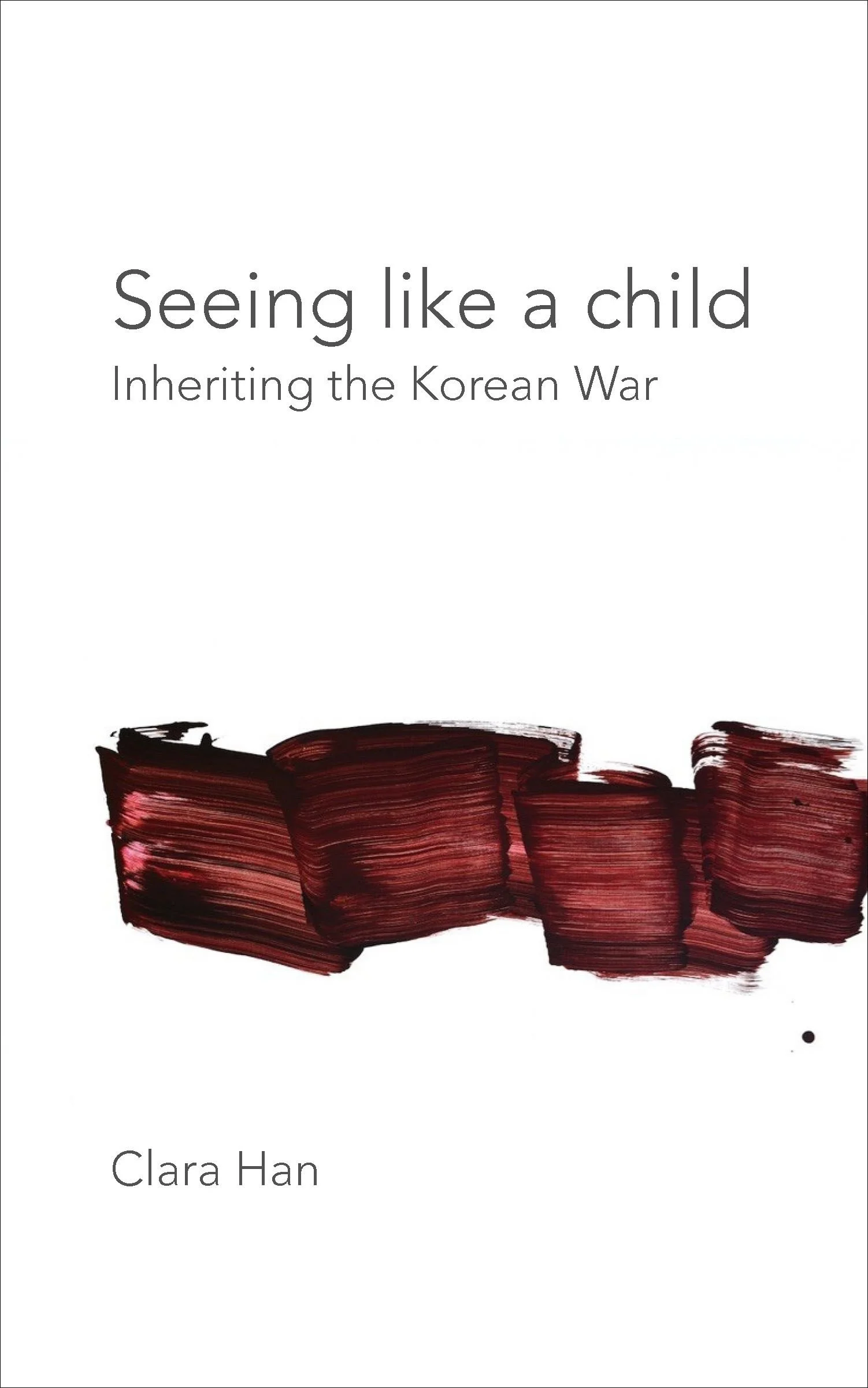
Seeing like a child: inheriting the korean War (Fordham, 2021)
Clara Han
Seeing Like a Child is a deeply moving narrative that showcases an unexpected voice from an established researcher. Through an unwavering commitment to a child’s perspective, Clara Han explores how the catastrophic event of the Korean War is dispersed into domestic life. Han writes from inside her childhood memories as the daughter of parents who were displaced by war, who fled from the North to the South of Korea, and whose displacement in Korea and subsequent migration to the United States implicated the fraying and suppression of kinship relations and the Korean language. At the same time, Han writes as an anthropologist whose fieldwork has taken her to the devastated worlds of her parents—to Korea and to the Korean language—allowing her, as she explains, to find and found kinship relationships that had been suppressed or broken in war and illness. A fascinating counterpoint to the project of testimony that seeks to transmit a narrative of the event to future generations, Seeing Like a Child sees the inheritance of familial memories of violence as embedded in how the child inhabits her everyday life.
Seeing Like a Child offers readers a unique experience—an intimate engagement with the emotional reality of migration and the inheritance of mass displacement and death—inviting us to explore categories such as “catastrophe,” “war,” “violence,” and “kinship” in a brand-new light.

Concepts de l'ordinaire (Éditions de la Sorbonne 2021)
Pierre Fasula et Sandra Laugier, eds.
Quelle connaissance avons-nous de l'ordinaire ? Quelle en est la grammaire ? Y a-t-il une normativité de l’ordinaire, ou relève-t-il d’une pure description ? Mais aussi plus largement, dans quelle mesure un même concept d’ordinaire permet-il de mieux comprendre ces vies que nous menons, des plus proches aux plus étrangères ? Enfin, quelle forme donner à ces vies ordinaires ? Telles sont les grandes lignes de ce volume consacré aux différentes approches conceptuelles de l’ordinaire. Depuis près de deux décennies maintenant, l’ordinaire – d’habitude minoré, ou négligé par la réflexion théorique – s’est en effet imposé comme un nouveau champ de recherches en philosophie et en sciences sociales. Ce volume collectif témoigne de la richesse et du caractère novateur de ces explorations, et cherche à établir plus fermement ce que l’on appellera les "concepts de l’ordinaire".
the politics of human life: rethinking subjectivity (routledge, 2021)
piergiorgio donatelli
This book centres on the notion of human life that lies at the foundation of contemporary thinking in the areas of ethics, law and politics.
Centrally, the book addresses the deep divide, characteristic of this thinking, between: on the one hand, those who wish to do away with any anthropological understandings of the human, and appeal to mere facts delivered by science; and, on the other hand, critics who defend an anthropological understanding of human life that is tied to traditional, teleological, metaphysics. In short: knowledge of the world is given over to the sciences and moral theory is considered to operate in a distinct, and insulated, domain. But this opposition has, Piergiorgio Donatelli argues here, outlived its usefulness. Through a discussion of the intimate human spheres of reproduction, dying and sexuality, he argues that we now live in a world characterized by new ways of living: by novel rearrangements of emotions, and by the modification, and in some cases a radical rupture in, existing ideas of human life. These shifts challenge any established separation between facts and norms, between human life and its conceptualization. As such, it is argued here, they simultaneously offer the possibility of a new, socially articulated, understanding of the relationship between subjectivity and normativity.
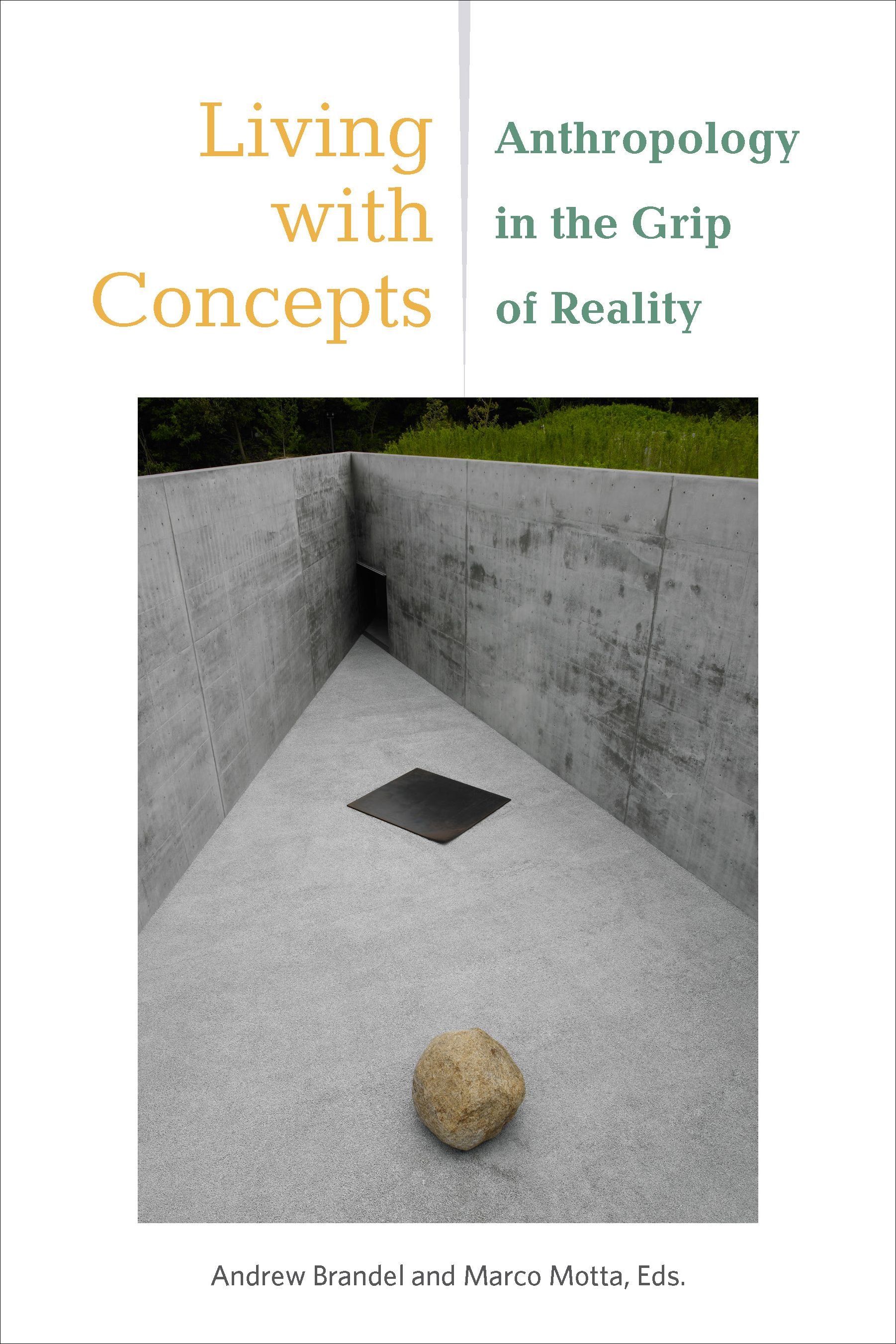
Living with Concepts: Anthropology in the Grip of Reality (Fordham, 2021)
Andrew Brandel and Marco Motta, eds.
This volume examines an often taken for granted concept—that of the concept itself. How do we picture what concepts are, what they do, how they arise in the course of everyday life? Challenging conventional approaches that treat concepts as mere tools at our disposal for analysis, or as straightforwardly equivalent to signs to be deciphered, the anthropologists and philosophers in this volume turn instead to the ways concepts are already intrinsically embedded in our forms of life and how they constitute the very substrate of our existence as humans who lead lives in language.
Attending to our ordinary lives with concepts requires not an ascent from the rough ground of reality into the skies of theory, but rather acceptance of the fact that thinking is congenital to living with and through concepts. The volume offers a critical and timely intervention into both contemporary philosophy and anthropological theory by unsettling the distinction between thought and reality that continues to be too often assumed and showing how the supposed need to grasp reality may be replaced by an acknowledgement that we are in its grip.

Textures of the Ordinary: Doing anthropology after wittgenstein (Fordham University Press 2020)
veena Das
How might we speak of human life amid violence, deprivation, or disease so intrusive as to put the idea of the human into question? How can scholarship and advocacy address new forms of war or the slow, corrosive violence that belie democracy's promise to mitigate human suffering? To Veena Das, the answers to these question lie not in foundational ideas about human nature but in a close attention to the diverse ways in which the natural and the social mutually absorb each other on a daily basis.
Textures of the Ordinary shows how anthropology finds a companionship with philosophy in the exploration of everyday life. Based on two decades of ethnographic work among low-income urban families in India, Das shows how the notion of texture aligns ethnography with the anthropological tone in Wittgenstein and Cavell, as well as in literary texts.
Das shows that doing anthropology after Wittgenstein does not consist in taking over a new set of terms such as forms of life, language games, or private language from Wittgenstein’s philosophy. Instead, we must learn to see what eludes us in the everyday precisely because it is before our eyes. The book shows different routes of return to the everyday as it is corroded not only by catastrophic events but also by repetitive and routine violence within everyday life itself. As an alternative to normative ethics, this book develops ordinary ethics as attentiveness to the other and as the ability of small acts of care to stand up to horrific violence.
Textures of the Ordinary offers a model of thinking in which concepts and experience are shown to be mutually vulnerable. With questions returned to repeatedly throughout the text and over a lifetime, this book is an intellectually intimate invitation into the ordinary, that which is most simple yet most difficult to perceive in our lives.
——
Events:
American Philosophical Association Meetings, January 9-11, 2020, Philadelphia
Author Meets Critics: Veena Das, Textures of the Ordinary
Chair: Alice Crary (New School for Social Research)
Critics: Sandra Laugier (Paris 1 Sorbonne) and Penelope Deutscher (Northwestern University)
Author: Veena Das (Johns Hopkins University)

la fragilité du souci de autres (ENS éditiones 2018)
Estelle Ferrarese
Ce livre renouvelle et acère la théorie critique par le féminisme. L’auteure interroge la philosophie sociale de Theodor W. Adorno au moyen de certaines des idées défendues par les théories du care afin de penser la fragilité sociale du souci des autres et ses enjeux politiques. Elle montre que la forme de vie capitaliste, tendue par une indifférence généralisée, n’en produit pas moins une attention à autrui compartimentée, limitée à des tâches et à des domaines bien particuliers et impartie aux femmes.
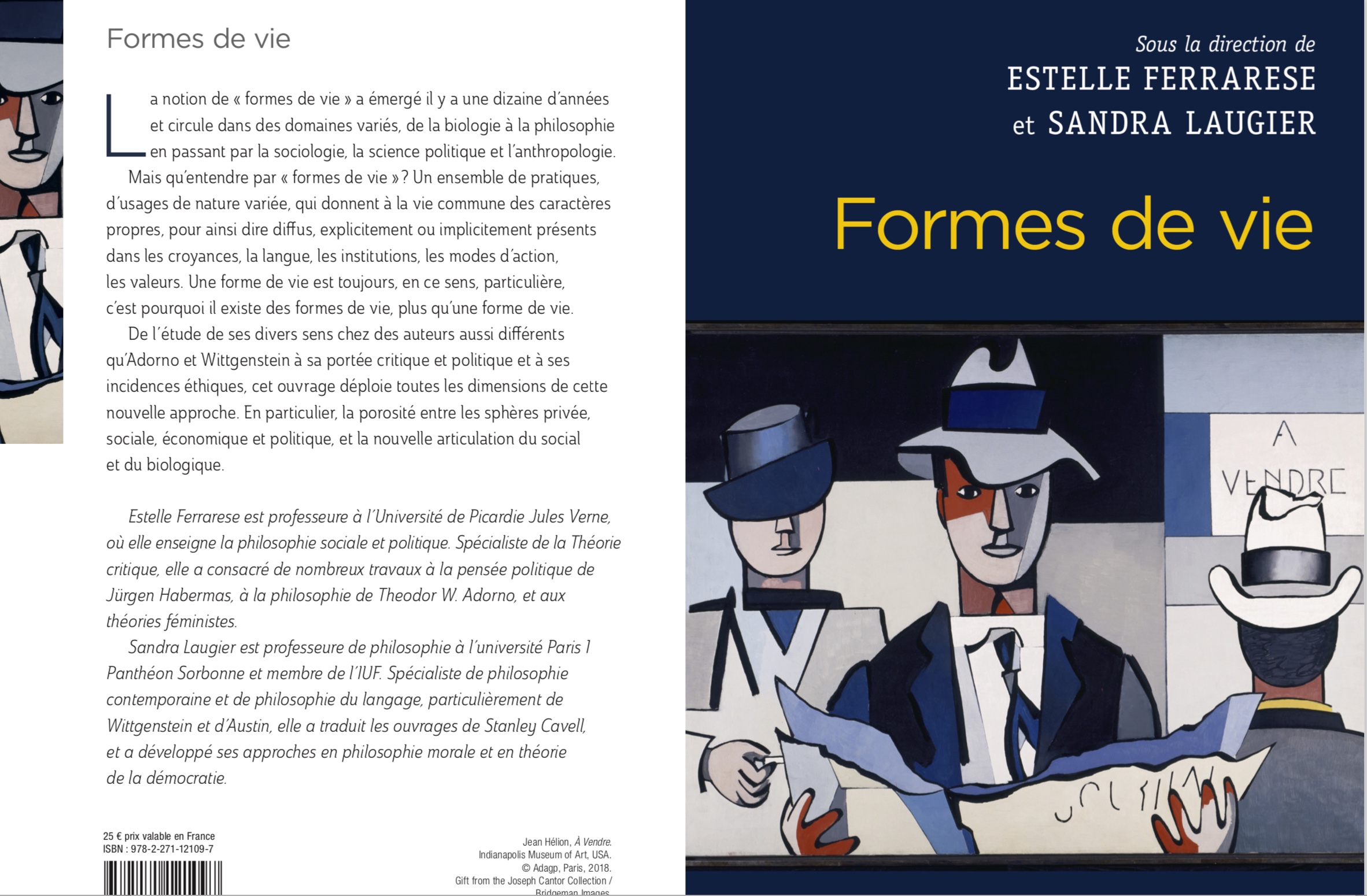
Formes de Vie (CNRS Editions 2018)
Estelle Ferrarese et Sandra Laugier
La notion de « formes de vie » a émergé il y a une dizaine d’années et circule dans des domaines variés, de la biologie à la philosophie en passant par la sociologie, la science politique et l’anthropologie.
Mais qu’entendre par « formes de vie »? Un ensemble de pratiques, d’usages de nature variée, qui donnent à la vie commune des caractéres propres, pour ainsi dire diffus, explicitement ou implicitement présents dans les croyances, la langue, les institutions, les modes d’action,
les valeurs. Une forme de vie est toujours, en ce sens, particulière, c’est pourquoi il existe des formes de vie, plus qu’une forme de vie.
De l é’tude de ses divers sens chez des auteurs aussi différents qu’ Adorno et Wittgenstein à sa portée critique et politique et à ses incidences éthiques, cet ouvrage déploie toutes les dimensions de cette nouvelle approche. En particulier, la porosité entre les sphères privée, sociale, économique et politique, et la nouvelle articulation du sociale
et du biologique.

how capitalism Forms Our lives (Journal for cultural research 2018)
reprinted by routledge 2019
Alyson Cole and Estelle Ferrarese, eds.
Table of Contents
Alyson Cole and Estelle Ferrarese, “How capitalism forms our lives”
Max Horkheimer, “The State of Contemporary Social Philosophy and the Tasks of an Institute for Social Research (1931)”
Rahel Jaeggi, “Economy as social practice”
Estelle Ferrarese, “The use of bodies. Agamben’s idea of a non-capitalist form of life”
David Harvey, “Universal alienation”
Frances Fox Piven, “The enduring regulation of the poor”
Daniele Lorenzini, “Governmentality, subjectivity, and the neoliberal form of life”
Alyson Cole, “The subject of objects: Marx, new materialism, & queer forms of life”
Victoria Hattam, “The whiteness of capital”
Cedric G. Johnson, “Beyond the barricades: class interest and actually existing black life”
Timothée Haug, “The capitalist metabolism: an unachieved subsumption of life under the value-form”
Sharon P. Holland, “Vocabularies of vulnerability”

Inventer des formes de vie (Multitudes 2018)
Sandra Laugier ed.
La démocratie comme enquête et comme forme de vie
La notion de forme de vie se retrouve aujourd’hui dans des contextes théoriques divers – Théorie critique, Wittgenstein, biopolitique, étude des styles et anthropologies de la vie. Elle permet de penser de nouvelles formes de critique et d’éthique dans un monde touché par le changement global et la radicalisation des inégalités sociales, sanitaires et environnementales. Au-delà de la vulnérabilité des formes de (la) vie humaine, apparue en situations de désastre ou de dénuement, le concept de formes de vie s’est également développé à l’articulation du social et de la vie pour décrire les diverses façons de faire inventivité et créer de nouvelles formes de vie. Cette présentation vise à rendre compte de la transformation en cours que signale cet usage dans des domaines tels le travail, la critique sociale ou l’innovation démocratique et les lieux où s’expérimentent de nouvelles formes de vie démocratique.

the subject of objects: Marx, new materialism, & queer forms of life (Journal for cultural research 2018)
alyson cole
This article examines two interrelated themes in the scholarship categorized as ‘new materialism’: first, the aim to undermine the subject/object distinction; second, the proposition that agency exists across the material world. While new materialists, such as Jane Bennett, conceive of their approach as an intervention against the injurious effects of capitalism, I argue that destabilizing the object/subject binary and endowing inanimate objects with vitality and agency is actually a constitutive feature of capitalism itself. To illustrate this point, I turn to Marx’s analysis, providing a queer reading of his theorization of commodities. Revisting Marx’s account of commodity fetishism in tandem with new materialism yields fresh insights into the logics of capitalism, specifically, the manner in which it thrives on concurrently producing and erasing subjectivities, thereby distorting social materiality and material sociality.

the politics of vulnerability (routledge 2017)
estelle ferrarese, ed.
Table of Contents
Estelle Ferrarese, “Vulnerability: A Concept with Which to Undo the World As It Is?”
Robert Castel, “The Rise of Uncertainties”
Veena Das, “The Boundaries of the "We:" Cruelty, Responsibility and Forms of Life”
Penelope Deutscher, “On the Whole We Don’t:" Michel Foucault, Veena Das and Sexual Violence”
Sandra Laugier, “Politics of Vulnerability and Responsibility for Ordinary Others”
Estelle Ferrarese, “The Vulnerable and the Political: On the Seeming Impossibility of Thinking Vulnerability and the Political Together and Its Consequences”
Noémi Michel, “Accounts of Injury as Misappropriations of Race: Towards a Critical Black Politics of Vulnerability”
Alyson Cole, “All of Us Are Vulnerable, But Some Are More Vulnerable than Others: The Political Ambiguity of Vulnerability Studies, an Ambivalent Critique”

All of Us are Vulnerable, But Some are More Vulnerable Than Others: The Political Ambiguity of Vulnerability Studies, An Ambivalent Critique (Critical Horizons 2016)
Republished in Turkish “Hempimiz Yaralanabirliriz, Ama Bazilari Digerlerinden Daha Cok Yaralanbilirlik” Cogito (Yaz 2017)
This paper raises several concerns about vulnerability as an alternative language to conceptualize injustice and politicize its attendant injuries. First, the project of resignifying “vulnerability” by emphasizing its universality and amplifying its generative capacity, I suggest, might dilute perceptions of inequality and muddle important distinctions among specific vulnerabilities, as well as differences between those who are injurable and those who are already injured. Vulnerability scholars, moreover, have yet to elaborate the path from acknowledging constitutive vulnerability to addressing concrete injustices. Second, vulnerability studies respond to, and have been shaped by, debates in the 1980s and 1990s over oppression, identity and agency. This genealogy needs to be acknowledged and evaluated. As I demonstrate, prominent theorists define vulnerability in contradistinction to victimization, adopting neo-liberal formulations of victims and victimhood. Finally, I turn to address the politics of vulnerability. At issue are not simply matters of utility or programmes for implementation, but the fraught relationship among ontology, ethics and politics, which I address through an engagement with Rancière's conception of the political and the case of the Black Lives Matter movement.
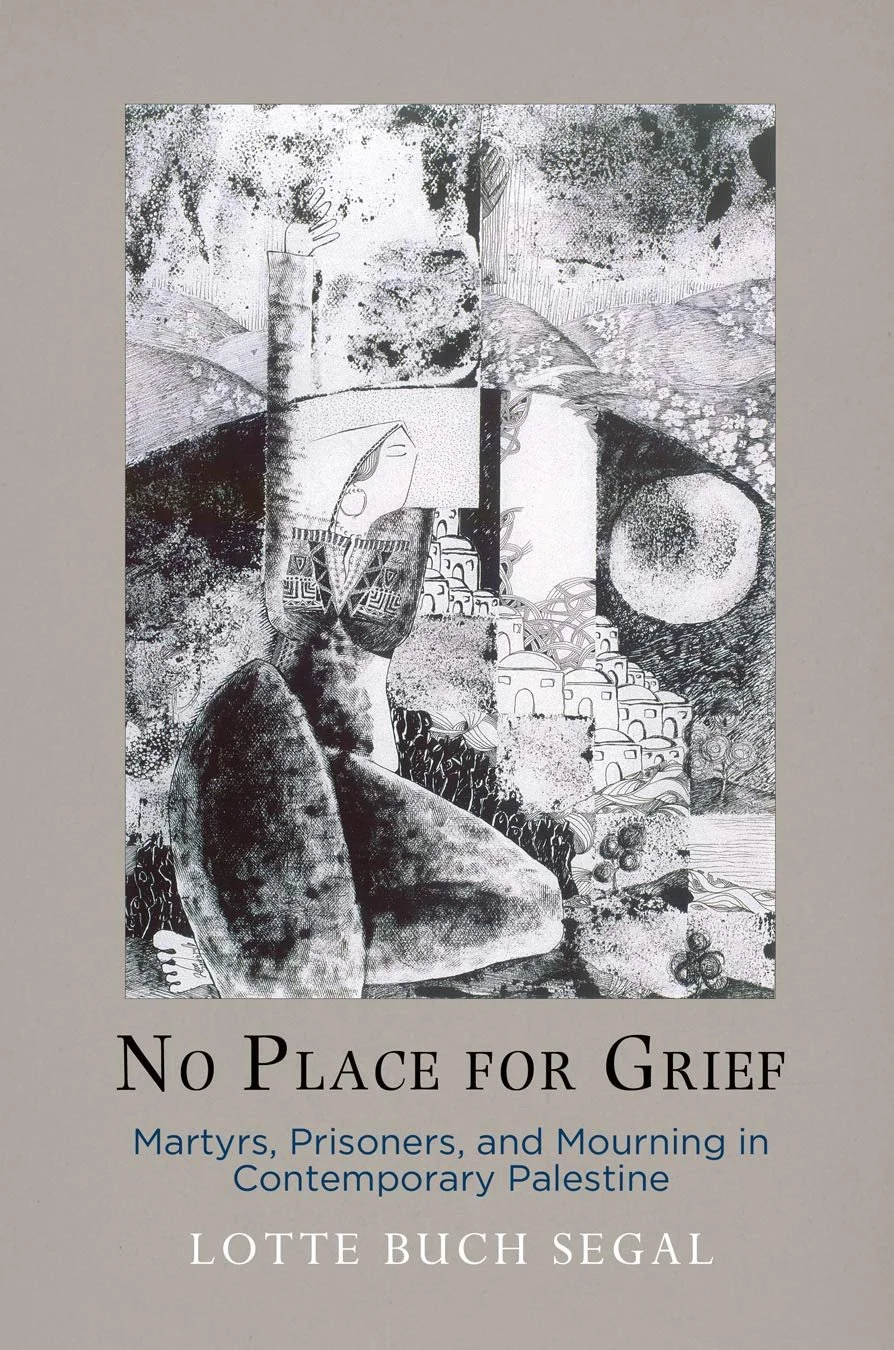
No Place for Grief: Martyrs, Prisoners, and Mourning in Contemporary Palestine (Penn Press, 2016)
Lotte Buch Segal
Westerners 'know' Palestine through images of war and people in immediate distress. Yet this focus has as its consequence that other, less spectacular stories of daily distress are rarely told. Those seldom noticed are the women behind the men who engage in armed resistance against the military occupation: wives of the Palestinian prisoners in Israeli detention and the widows of the martyrs. In Palestine, being related to a detainee serving a sentence for participation in the resistance activities against Israel is a source of pride. Consequently, the wives of detainees are expected to sustain these relationships through steadfast endurance, no matter the effects upon the marriage or family. Often people, media, and academic studies address the dramatic violence and direct affliction of the Palestinians. Lotte Buch Segal takes a different approach, and offers a glimpse of the lives, and the contradictory emotions, of the families of both detainees and martyrs through an in-depth ethnographic investigation.
No Place for Grief asks us to think about what it means to grieve when that which is grieved does not lend itself to a language of loss and mourning. What does it mean to "endure" when ordinary life is engulfed by the emotional labor required to withstand the pressures placed on Palestinian families by sustained imprisonment and bereavement? Despite an elaborate repertoire of narrative styles, laments, poetry, and performance of bodily gestures through which mourning can be articulated, including the mourning tied to a political cause, Buch Segal contends that these forms of expression are inadequate to the sorrow endured by detainees' wives. No Place for Grief reveals a new language that describes the entanglement of absence and intimacy, endurance and everyday life, and advances an understanding of loss, mourning, and grief in contemporary Palestine.
Living and Dying in the Contemporary World: A Compendium (UC Press, 2015)
Veena Das and Clara Han, eds.
Taking a novel approach to the contradictory impulses of violence and care, illness and healing, this book radically shifts the way we think of the interrelations of institutions and experiences in a globalizing world. Living and Dying in the Contemporary World is not just another reader in medical anthropology but a true tour de force—a deep exploration of all that makes life unbearable and yet livable through the labor of ordinary people.
This book comprises forty-four chapters by scholars whose ethnographic and historical work is conducted around the globe, including South Asia, East Asia, Latin America, Africa, the Middle East, Europe, and the United States. Bringing together the work of established scholars with the vibrant voices of younger scholars, Living and Dying in the Contemporary World will appeal to anthropologists, sociologists, health scientists, scholars of religion, and all who are curious about how to relate to the rapidly changing institutions and experiences in an ever more connected world.

Verbicide. D’une vulnérabilité qui n’ose dire son nom / Verbicide: The Vulnerability that Dare Not Speak Its Name (Les Cahiers du Genre 2015)
alyson cole
This article explores the discursive process that shaped contemporary understandings of vulnerability, highlighting recurrent attempts to rework the relationship between victimization and blame. I trace uses of the phrase “blaming the victim,” from sociologist William Ryan’s 1970 coinage in his critique of efforts to assist vulnerable populations to the contemporary conservative campaigns against “victim politics.” The blame/victim nexus also takes us to the science of victimology that emerged in the aftermath of the WWII to gauge “victim precipitation,” the works of psychologist Melvin Lerner who documented that individuals in fact do blame victims, feminists’ protests against “blaming the rape victim,” and finally the Victims’ Rights Movement. This genealogy of the rhetorical work of the phrase “blaming the victim” and it depoliticizing effects demonstrates how causes formulated in terms of victimhood increasingly concentrate on the therapeutic utility of blaming, often occluding the material consequences of victimization or its remedy.
Full list of publications
Edited/collective books (including 2 members or more)
Brandel, Andrew, and Marco Motta, eds. 2020. Living with Concepts: Anthropology and Philosophy in the Grip of Reality. New York: Fordham University Press.
Brandel, Andrew, Veena Das, Sandra Laugier, and Perig Pitrou, eds. 2025. A Matter of Detail: Philosophy, Anthropology, Aesthetics. Toronto: University of Toronto Press.
Das, Veena, and Clara Han, eds. 2015. Living and Dying in the Contemporary World: A Compendium. Berkeley: University of California Press.
Das, Veena, Michael Jackson, Arthur Kleinman, and Bhrigupati Singh, eds. 2014. The Ground Between: Anthropologists Engage Philosophy. Duke University Press.
Ferrarese, Estelle, ed. 2017. The Politics of Vulnerability. London: Routledge.
Ferrarese, Estelle, and Sandra Laugier, eds. 2018. Formes de vie. Paris: Éditions du CNRS.
Laugier, Sandra, ed. 2022. Concepts de l'ordinaire. Paris: Éditions de la Sorbonne.
Laugier, Sandra, Jasmin Trächtler, C. Igg Cabrera, and C. Braune, eds. 2025. The Bloomsbury Handbook of Wittgensteinian Feminism. London: Bloomsbury.
Lovell, Anne, Stefania Pandolfo, Sandra Laugier, and Veena Das 2013. Face aux désastres: Le care, la folie et les grandes détresses collectives. Paris: Éditions Ithaque.
Journal issues (including 2 members of the group or more)
Brandel, Andrew, and Sandra Laugier, eds. 2023. "For an Ordinary Aesthetics." Special issue, Open Philosophy 6 (1): 1–160.
Donatelli, Piergiorgio, ed. 2024: Symposia: Reframing Global Risks. Iride 37, no. 1.
Ferrarese, Estelle, and Sandra Laugier. 2015. "Politique des formes de vie." Raisons politiques, n° 57
Ferrarese, Estelle, and Sandra Laugier. 2018. "L'invention des formes de vie." Multitudes, n° 71.
Cole, Alyson, and Estelle Ferrarese. 2018. "How Capitalism Forms Our Lives." Journal for Cultural Research 22 (2): 105–121.
Laugier, Sandra, ed. 2021-2022. "Ethics and Politics of TV Series." Special issue, Open Philosophy 5 .
Ferrarese, Estelle. 2022. "Formes de vie, formes de politique." Archives de philosophie, Tome 85, Cahier 3
Ferrarese, Estelle. 2016. “The Politics of Vulnerability”, Critical Horizons: A Journal of Philosophy and Social Theory 17
Floyd, Juliet, and Sandra Laugier, eds. 2025. "Wittgenstein and Forms of Life: Futures of a Concept." Special issue, Philosophies.
Allouche, Sylvie, Sandra Laugier, eds. 2015. "Nouvelle robotique, nouveaux vivants" , "Le care des robots". Multitudes, n° 58.
Laugier, Sandra, Pascale Molinier, and Jules Falquet. 2015. "Care, environnement et éthique globale." Cahiers du Genre, n° 59: 127–152.
Individual books on Forms of life
Brandel, Andrew. 2023. Moving Words: Memory, Migration, and Literature in Berlin. Toronto: University of Toronto Press.
Brandel, Andrew. 2027. Anthropology and its Literary Companions. Minneapolis: University of Minnesota Press
Das, Veena. 2007. Life and Words: Violence and the Descent into the Ordinary. Berkeley: University of California Press.
Das, Veena. 2015. Affliction: Health, Disease, Poverty. New York: Fordham University Press.
Das, Veena. 2020. Textures of the Ordinary: Doing Anthropology after Wittgenstein. New York: Fordham University Press.
Das, Veena. 2022. Slum Acts. London: Polity Press
Donatelli, Piergiorgio. 2012. La vita umana in prima persona. Gius. Laterza & Figli Spa.
Donatelli, Piergiorgio. 2020. La filosofia e la vita etica. Turin: Einaudi.
Ferrarese, Estelle, 2018. La fragilité du souci des autres. Adorno et le care, Lyon, Editions de l’ENS.
Engl. translation: The Fragility of Concern for others. Adorno and the Ethics of Care, Edinburgh, Edinburgh University Press, 2020
Ferrarese, Estelle. 2023. Le Marché de la vertu: Critique de la consommation éthique. Paris: Vrin. Engl. translation: The Market of Virtue. A critique of Ethical Consumerism, Edinburgh University Press, 2026 (in press)
Han, Clara. 2012. Life in Debt: Times of Care and Violence in Neoliberal Chile. Berkeley: University of California Press.
Han, Clara. 2021. Seeing Like a Child: Inheriting the Korean War. New York: Fordham University Press.
Han, Clara. 2026. Echoes of a Death: Police Violence and the Singularity of a Life. New York: Fordham University Press
Laugier, Sandra. 2013. Why We Need Ordinary Language Philosophy. Chicago: University of Chicago Press. Paperback reedition, 2024.
Laugier, Sandra, and Albert Ogien. 2014. Le Principe Démocratie. Paris: La Découverte. German translation, 2020.
Laugier, Sandra. 2015. Etica e politica dell'ordinario. Milan: LED Edizioni.
Laugier, Sandra. 2019. Nos vies en séries: Philosophie et morale d'une culture populaire. Paris: Flammarion.
Laugier, Sandra, and Najat Vallaud-Belkacem. 2020. La société des vulnérables. Paris: Gallimard.
Laugier, Sandra. 2020. Politics of the Ordinary: Care, Ethics, Forms of Life. Leuven: Peeters.
Laugier, Sandra. 2021. En confinement: Du care en séries et la 2e vague des séries féministes. Paris: Éditions AOC.
Laugier, Sandra. 2021. Wittgenstein: Politique de l'ordinaire. Paris: Vrin. Italian translation, Castelvecchi, 2024.
Laugier, Sandra. 2023. TV-Philosophy: How TV Series Change Our Thinking. Exeter: University of Exeter Press.
Laugier, Sandra. 2023. TV-Philosophy in Action: The Ethics and Politics of TV Series. Exeter: University of Exeter Press.
Laugier, Sandra. 2024. Vulnerabilità e forme di vita: Wittgenstein e la politica dell'ordinario. Rome: Castelvecchi.
Laugier, Sandra. 2025. Wittgenstein: The Senses of Use. Chicago: University of Chicago Press.
Mellier, Denis and Perig Pitrou 2025, Fragilités des vies humaines. Ithaque Éditions.
Pitrou, Perig. 2022. Les anthropologues et la vie. Milan: Mimesis Éditions.
Pitrou, Perig. 2024. Ce que les humains font avec la vie. Paris: Presses universitaires de France.
Segal, Lotte Buch. 2016. No Place for Grief: Martyrs, Prisoners, and Mourning in Contemporary Palestine. Philadelphia: University of Pennsylvania Press.
Individual / co-signed articles and chapters
Brandel, Andrew, and Swayam Bagaria. 2020. "Plotting the Field: Fragments and Narrative in Malinowski's Stories of the Baloma." Anthropological Theory 20 (1): 29–52.
Brandel, Andrew. 2020. "Literature and Anthropology." In Oxford Encyclopedia of Anthropology, edited by Mark Aldenderfer. New York: Oxford University Press.
Brandel, Andrew, Veena Das, and Michael Puett. 2023. "Language in Flight: Home and Elsewhere" Sophia 62 (3): 449–483.
Brandel, Andrew, Piergiorgio Donatelli, and Lotte Buch Segal. 2026 “Book Forum on Moving Words”. Conflict and Society Vol 12.
Buch Segal, Lotte. 2021 “In the Know: Being with the Pain of Others in a Torture Rehabilitation Clinic”. In Concepts.Eds. A. Brandel and M. Motta. New York: Fordham University Press.
Buch Segal, Lotte. 2018. “Tattered textures of kinship: the effects of torture among Iraqi families in Denmark.” Medical Anthropology, 37(7), pp.553-567.
Buch Segal, Lotte. 2023. “Caring for the ordinary in Palestine: when ongoing occupation becomes maddening.” Anthropological Quarterly, 96(3), pp.437-460.
Buch Segal, Lotte. 2025. “Detailing Scenes of Ordinary Grief Across Ethnography and Poetry”. In: A Matter of Detail. Anthropology, Philosophy, and Aesthetics. Eds A.Brandel, V. Das, S. Laugier, and P. Pitrou. Toronto. University of Toronto Press.
Buch Segal, Lotte. 2026. “Connaître et reconnaître la torture” [Knowing and Acknowledging Torture] In Special Issue of A Contrario. Eds. Marco Motta, Yves Erard, Josephine Stebler.
Das, Veena. 2018. "Ethics, Self-Knowledge, and Life Taken as a Whole." HAU: Journal of Ethnographic Theory 8 (3): 537–549.
Das, Veena. 2020. "Of Mistakes, Errors, and Superstition." In The Mythology in Our Language: Wittgenstein's Remarks on Frazer, edited by Giovanni da Col and Stephan Palmié, 155–180. Chicago: HAU Books.
Svadzian, Anita, Benjamin Daniels, Giorgia Sulis, Jishnu Das, Amrita Daftary, Ada Kwan, Veena Das*, Ranendra Das, Madhukar Pai, 2023. “Do private providers initiate anti-tuberculosis therapy on the basis of chest radiographs? A standardized patient study in urban India." The Lancet Regional Health-Southeast Asia, 13.
Saria, Vaibhav, Das, Veena*, Daniels, B., Pai, M., & Das, J. 2023. "The family doctor: health, kin testing and primary care in Patna, India." Anthropology & Medicine, 3(3): 246-261.
Das, Veena and Vaibhav Saria. 2024. “Embracing Ignorance: A Jagged Path to Learning Between the Global and the Local.” Symposium on Global Risks, ed. Piergiorgio Donatelli. Iride, Filosofia e discussione pubblica 1: 61-88,
Das, Veena. 2025. “The Female Voice and the Movement of Thought” in The Bloomsbury Handbook of Wittgensteinian Feminism, Sandra Laugier, Isabel G. Gamero Cabrera, Jasmin Trächtler, Camille Braune (eds). London: Bloomsbury Academic Publications. pp. 141-164
Donatelli, Piergiorgio. 2025. "Language games in conversation: the ordinary as a site of criticism." Journal of Philosophy of Education 59, no. 5-6: 962-980.
Donatelli, Piergiorgio. 2016. “La vita, la bioetica, la democrazia.” Iride, 29(3), pp.497-508.
Ferrarese, Estelle. 2015. "Le projet politique d'une vie qui ne peut être séparée de sa forme: La politique de la soustraction de Giorgio Agamben." Raisons politiques, n° 57: 34–58.
Ferrarese, Estelle. 2018a. Vulnerability and Critical Theory. Leiden: Brill (Brill Research Perspectives in Critical Theory).
Ferrarese, Estelle. 2018b. "La vie et sa forme dans la philosophie d'Adorno." In Formes de vie, edited by Estelle Ferrarese and Sandra Laugier, 81-99. Paris: Éditions du CNRS.
Ferrarese, Estelle. 2018c. "La critique comme forme de vie démocratique." Multitudes, n° 71:189–198.
Ferrarese, Estelle. 2018d. "The Use of Bodies: Agamben's Idea of a Non-Capitalist Form of Life." Journal for Cultural Research 22 (2): 126–136.
Ferrarese, Estelle. 2022. "Difformer la vie: Réflexions adorniennes sur la transformation sociale et les formes de vie." Archives de philosophie, Tome 85, Cahier 2: 61-76.
Ferrarese, Estelle. 2024. "Care and the Market: Can We Consume with a Concern for Others?" In Ethics of Care: Theoretical and Practical Perspectives, edited by Joaquim Braga, 115-124. New York/Berlin: Springer.
Ferrarese, Estelle. 2025a. "Vulnerabilità e politica: Cartografia di una curiosa tendenza." In Vulnerabilità, rischio e crisi, ed. by Eugenia Gaia Esposito and Laura Turano, 11–32. Milan: Mimesis.
Ferrarese, Estelle. 2025b. "Tearing the Detail from the Totality: Adorno's Micrological Gaze." In A Matter of Detail: Anthropology, Philosophy, and Aesthetics, edited by Andrew Brandel, Veena Das, Sandra Laugier, and Perig Pitrou, 243–263. Toronto: University of Toronto Press.
Han, Clara. 2014. "The Difficulty of Kindness: Boundaries, Time, and the Ordinary." In The Ground Between: Anthropologists Engage Philosophy, edited by Veena Das, Arthur Kleinman, Michael Jackson, and Bhrigupati Singh, 71–93. Durham: Duke University Press.
Han, Clara. 2018. "Precarity, Precariousness, and Vulnerability." Annual Review of Anthropology 47: 331–343.
Han, Clara and Andrew Brandel. 2020. "Genres of Witnessing: Narrative, Violence, Generations." Ethnos 85 (4): 629–646.
Han, Clara. 2026. "Inheriting war in a form of life: affliction, death, loss"/ “Herdando a guerra na forma de vida: aflição, morte, perda” in Exilium: Revista de Estudos da Contemporaneidade (11) Pp. 79-92
Han, Clara. 2026. “Where is the Prison” in Echoes of Catastrophe: Political Violence and Everyday Life in Latin America. Chie Ishida (ed). Tokyo: Waseda University Press. (in Japanese)
Han, Clara. 2026. "Covid-19 in the Flux of Everyday Life: A view from the neighborhood" in Pierobon, Rui, and Murray (Eds.) "The Daily Lives of the Covid-19 Pandemic: Homes, Care and Public Policies in Brazil and Chile" Dossier, Sexualidade, Saúde e Sociedade (Institute of Social Medicine/University of Rio de Janiero), 42.
Laugier, Sandra. 2013. « Attention to Ordinary Others: Care, Vulnerability, and Human Security », Iride. Filosofia e discussion pubblica, n° 3/2013, p. 507-526.
Laugier, Sandra. 2015. “Care, environnement et éthique globale.” Genre et inégalités environnementales : nouvelles menaces, nouvelles analyses, nouveaux féminismes » (ed. J. Falquet, S. Laugier, P. Molinier), Cahiers du Genre, n° 59: 127-152.
Laugier, Sandra. 2015. "La vulnérabilité des formes de vie." Raisons politiques, n° 57: 65-80.
Laugier, Sandra. 2015. "Voice as Form of Life and Life Form." Nordic Wittgenstein Review 4: 63–81.
Laugier, Sandra. 2016. « Politics of Vulnerability and Responsibility for Ordinary Others », Critical Horizons , A Journal of Philosophy and Social Theory Volume 17, 2
Laugier, Sandra. 2016. Care, the Ordinary, Forms of Life », Iride. n° 1/2016, p. 109-121.
Laugier, Sandra. 2016. “Care, responsibility, and coexistence »- Etica e politica/Ethics and Politics, p. 91-107
Laugier, Sandra. 2018. « This is us: Wittgenstein and the Social », Philosophical Investigations, vol 41.
Laugier, Sandra. 2018. "Wittgenstein: Ordinary Language as Lifeform." In Language, Form(s) of Life, and Logic: Investigations after Wittgenstein, edited by Christian Martin, 277-304. Berlin: De Gruyter.
Laugier, Sandra. 2018.” Cavell on Feminism and the Ethics of Care”, Conversations, n°6.
Laugier, Sandra. 2019.“The Vulnerability of the Ordinary: Goffman, Reader of Austin,” Graduate Faculty Philosophy Journal 39:2
Laugier, Sandra. 2019. « L’anthropologie de la philosophie », in Claire Brunet, Frédérique Ildefonse, S. Laugier (éds.) Variations Claude Imbert. T&p Work Unit.
Laugier, Sandra. 2020. “Ordinary Realism in Ethics”, in The Ethics of Care: the State of the Art. F. Vosman, A. Bart, J. Hoffman, Peeters.
Laugier, Sandra. 2020. “The Texture of Importance”, in Ethics after Wittgenstein. Contemplation and Critique, Richard Amesbury, Hartmut von Sass, eds., Bloomsbury;
Laugier, Sandra 2020. “Encounters of the third kind: performative utterances and forms of life”, Inquiry 68 (6), 1480-1500.
Laugier, Sandra. 2020. "La vulnerabilità delle forme di vita : un nuovo inizio per l'etica" in Etica nel futuro. Orthotes Editrice, p. 13-30..
Laugier, Sandra. 2020. "The Anthropological Tone in Philosophy." In The Mythology in Our Language: Wittgenstein's Remarks on Frazer, ed. Giovanni da Col and Stephan Palmié. Chicago: HAU Books.
Laugier, Sandra. 2021. "Concepts and Forms of Life." In Living with Concepts: Anthropology in the Grip of Reality, edited by Andrew Brandel and Marco Motta. New York: Fordham University Press.
Laugier, Sandra. 2021. “Paradoxes in the Invisibility of Care Work”. Philosophical Topics 49 pp. 61-79.
Laugier, Sandra. 2022. “Moral Lessons from COVID” Philosophers' Magazine (UK) Philosophy Documentation Center (USA), « Inequality, Exclusion and Ethics », p. 88-94.
Laugier, Sandra. 2022. "La forme logique de la vie." Archives de philosophie 85, 77-97.
Laugier, Sandra. 2022. "What Gender Does to Moral Philosophy" in E. Le Jalle, A. Benoit, eds. Thinking with Women Philosophers Critical Essays in Practical Contemporary Philosophy, Springer.
Laugier, Sandra. 2022. “Wittgenstein and Care Ethics as a Plea for Realism” Philosophies 7(4), 86.
Laugier, Sandra. 2023. "Vulnerability and Gender after COVID-19." In Vulnerabilities: Rethinking Medicine, Rights, and Humanities in the Post-Pandemic, 79-92. Springer International Publishing.
Laugier, Sandra. 2024. "Care, Risk, Collapse." Iride 36: 89-108.
Laugier, Sandra. 2024. "From the Ordinary to the Everyday." Qui Parle 33 (1): 17-34.
Laugier, Sandra. 2025. "Care Ethics as a Transformation in Moral Philosophy." In The Bloomsbury Handbook of Care Ethics, ed. Matilda Carter, Bloomsbury.
Pitrou, Perig. 2014. "La vie, un objet pour l'anthropologie? Options méthodologiques et problèmes épistémologiques." L'Homme, n° 212: 159–189.
Pitrou, Perig. 2015. "Life as a Process of Making in the Mixe Highlands (Oaxaca, Mexico): Towards a 'General Pragmatics' of Life." Journal of the Royal Anthropological Institute 21 (1): 86–105.
Pitrou, Perig. 2017. "Life Form and Form of Life within an Agentive Configuration: A Birth Ritual among the Mixe of Oaxaca, Mexico." Current Anthropology 58 (3): 360–380.